Thursday, May 16, 2019

Nefertum's Wesekh


When I saw the Beadworkers Guild challenge theme for 2019, "Jewels of the Nile", my first thought was to not make a collar. No way! Because there are so many out there already and amazing ones. So I searched for what could be another Jewel of the Nile and found the Egyptian blue lotus flower and god Nefertum.
Oh my!

Nymphaea caerulea. The Egyptian blue lotus is, in fact, a waterlily, but most call
 it the Egyptian blue lotus

I instantly fell in love with this beautiful waterlily and started my first creation immediately: a small vessel for tooth picks representing the waters of the Nile with the flower floating atop of it.
    
However, this was not a very stable construction, and the crystal beads in the vessel  - which is a bola canastas made with diagonal Cellini peyote - cut the thread without mercy. Twice...


This had the merit to answer my question as to keep the flower as a toothpick holder or not: I repaired the vessel mimicing the art of Kitsugi to forever remind me that crystals are not bola-friendly, and made that a nice toothpick holder, and created a barrette with the flower (not yet finished).


This is a sign that Eddie didn't hear it this way (Eddie is my muse and tyrant). He wanted a wesekh. Nefertum's wesekh. Bead woven. Of course!
The rules of the Guild's challenge say "we urge members to concentrate on the personal challenge - to be as good as they can, rather than pitting themselves against others". Bead embroidery would not have been easy for me. Rather the contrary. But to weave a dense collar with a curve that doesn't ruffle yet still moves with the wearer's movements, is a challenge, at least for me. So I gave in.

But before writing more about the making of the collar, I wish to tell more about lord Nefertum and his attribute, the sacred blue lotus:

Antelope with
lotus flower
The Egyptian sacred Lotus flower

While doing my research, I discovered that lotus flowers can be seen in countless ancient Egyptian tomb wall paintings and temple carvings, from the oldest to the most recent dynasties. It is everywhere: in people's hair or hands, in large collars, on piles of offerings to the gods, etc. Even around an antelope's neck. Some temples even have columns with lotus-inspired forms.

Painting of Funeral banquet in Rekhmire's tomb at Luxor,
showing servants offering lotus flower necklaces to
female guests who are seated on mats.
Photo Mick Palarczyk and Paul Smit
The god

In early Egyptian mythology, Nefertum was believed to be the first god, the young Atum (Nefertum means beautiful Atum, or youthful Atum), who came out of the blue out of a blue lotus that emerged from the primeval waters of Nun. He cried because he was alone and his tears created humanity.

Egypt, Tomb of Ramses I, Pharaoh (center)
presenting offerings to Nefertum (left)

Atum was a solar deity, so Nefertum represented the sunrise. He matured into Atum during the day before passing into the world of the dead with every sunset.

Later, as time wore on, Atum became assimilated into Ra (as Atum-Ra), the sacred scarab became the symbol of the rising sun, and so it came to be that people regarded Nefertum as a separate deity. The lotus flower never lost its popularity though. Rather the contrary.
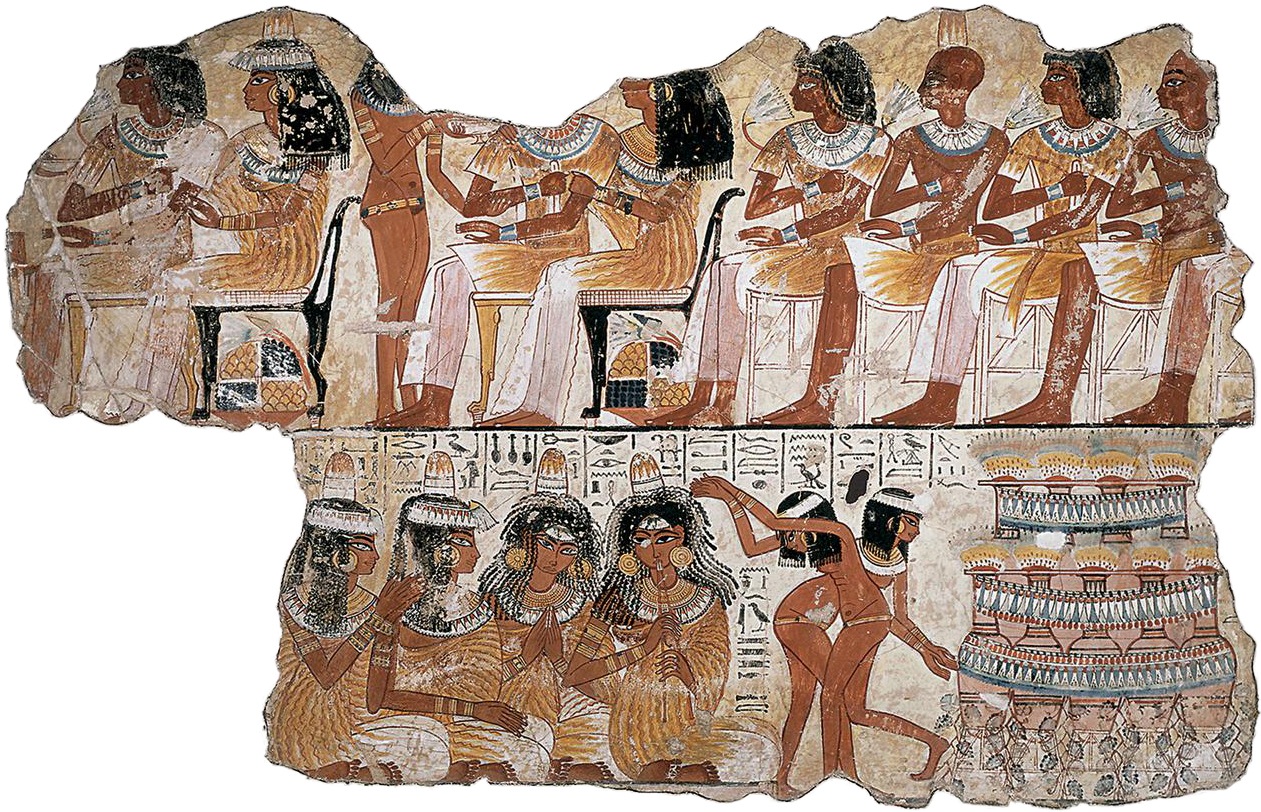
Another funeral banquet (of Nebamum) showing
musicians and servants dancing and offering
lotus flowers and flower necklaces to guests

The Egyptian geranium
smells like roses
In the Pyramid Texts (book of the death), Nefertum is said to be the scent of the lotus flower which is held before the nose of the aging god Ra:

"Rise like Nefertum from the blue water lily, to the nostrils of Ra (the creator and sungod), and come forth upon the horizon each day."

Priest (botanist or
aromatherapist?)
 with botanical
attributes and
offerings.
I think that the heavenly smell of the flower is both a memory and a 'promise': the soon to come rebirth in the lotus flower (the next morning). For the Egyptians, the flower represented rebirth and they celebrated the passing of a dear one as the beginning of a new life. Of course there are many other - sometimes contradictory - legends and myths and gods.

Nefertum eventually became the lord of perfumes, patron of the cosmetic and healing arts derived from flowers. Associated to other medicinal flowers, such as geranium (another divine smell) and cornflower, he could be described as the archetypal aromatherapist.

Actually, this blue lotus study made me order blue lotus essential oil. It smells divine and has no narcotic effects. Learn more about my love of scents in my article Perfumes and Pomanders.

What is a wesekh and / or a menat

I thought that a broad collar was called a menat, another name of goddess Hathor, whose attribute was a collar with a heavy counterpoise. It was used by her and her priestesses as a rattle for blessings.
In fact, wesekh is the name of the large Egyptian collar, thought to have many (protective) properties, hence worn by men and by women, and the menat is the name of the counterpoise, keeping it in place.

18th Dynasty Menat (approx. 1300 BC)

Many ancient Egyptian wesekh represent the wings of a vulture or a scarab. The golden counterpoises in the one shown below can hold it without need for a clasp. If you look at the two images below in full screen you can appreciate the fine craftsmanship of the Egyptians.

Senebtisi's collar, formed  of two golden falcon
heads. Approx. 1850-1775 B.C.
© The Metropolitan Museum of Arts, New-York
The colors

The Brooklyn Museum experts say: "For the Egyptians the lighter shade of blue was almost interchangeable with green, the color of the sea, plants, vegetation, and thus health and life. The darker shade of blue was associated with the dark primordial waters out of which creation first appeared, as well as the night sky through which the sun-god traveled to be reborn every morning. Naturally, blue-green faience and blue glass were cheaper alternatives to turquoise and lapis-lazuli."

Obviously, bugle beads and dagger beads are not new beads :) Isn't this amazing?
Broad Collar, ca. 1336-1327 B.C.E., ca. 1327-1323 B.C.E., or ca.1323-1295 B.C.E.
Faience, 14 7/16 x 4 7/16 in. (36.6 x 11.3 cm). Brooklyn Museum,
Charles Edwin Wilbour Fund, 40.522. Creative Commons-BY
(Photo: Brooklyn Museum, 40.522_SL1.jpg)
Visit the Brooklyn's Museum page to learn more about this piece.

Techniques

The ancient Egyptians invented enameling. They were master goldsmiths. They were masters at bead making and bead weaving. They even made some sort of seed beads. The piece above includes incredibly tiny seed beads. Looking closer at it, I realized that my collar looks as if it is made with a method very similar to the one they used.

The Egyptians already used peyote stitch to weave seed beads. A pair of beaded sandals found back in King Tut's tomb attests of this technique and of the "seed" beads existing already back then (although probably not made like seed beads, but rather one by one, by hand...)

King Tutankhamon's sandals made with "peyote" stitch

Making of my challenge piece, Nefertum's wesekh

I found the idea of humans created by the tears of the morning sun or god a wonderful legend, so I planned on including teardrops in the collar as a main design feature. Even if faceted gemstones, or diamonds, are not present in ancient Egyptian jewellery, this was the story that I decided to translate


Like all important deities, one of Nefertum's attributes is the Ankh symbol. I first thought of using it for the clasp, but my second carnelian cabochon had a white stripe across and was begging to be transformed into a scarab. I made a scarab clasp with it.
Techniques used: a mix of netting and DW for a dense weave. It was difficult to get the curve right, but the result is so delightful to wear. It perfectly adapts to my neck and movements and doesn't ruffle!

Decisions, decisions....
For te bottom row I tried several options before deciding on the final one.


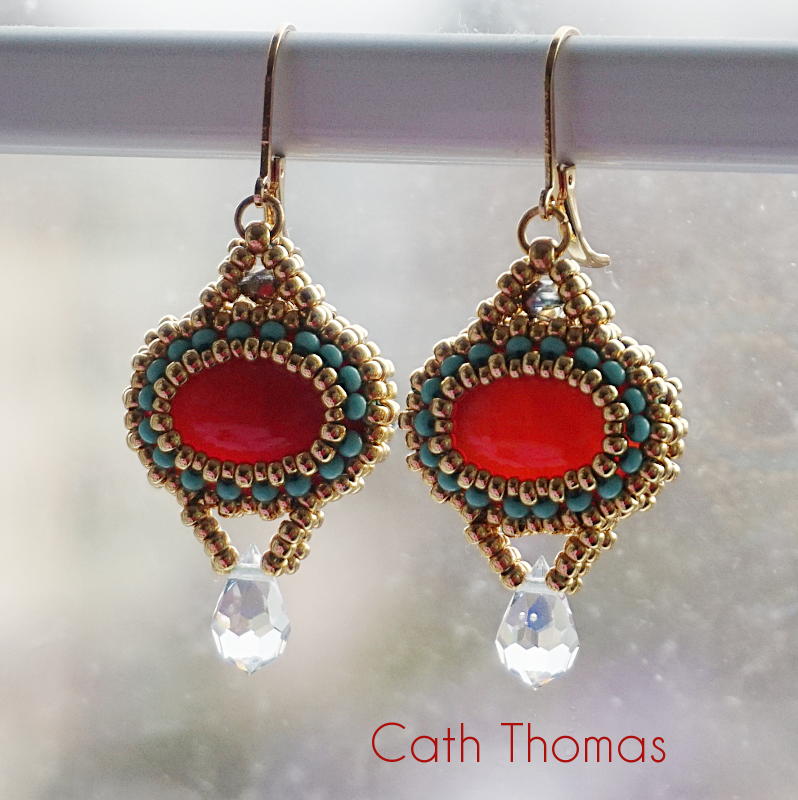
Matching earrings
 
As for challenging myself: nearly everything in this collar was out of my comfort zone: unusual colors (for me), stitches I nearly never use, bead embroidery, and a difficult theme for my usual style: it is hard to keep proportions small or medium when it comes to this magnificent civilization.

My beading mat looked like a battle field.


Clasp
 
I couldn't be happier with this necklace. When I wear it, I feel amazing! 


Cherry on the cake: the hubby said that Cleopatra would have killed to have it!

One more photo of the earrings:

I love how they let the light shine through.

Thank you very much fore reading this long article!

Cath,

incredibly happy winner of the first place in the "Expert" category of the BWG 2019 Challenge.

Become a member of the Beadworker's Guild - we're a beautiful family of beaders united by our love of beading, and get their beautiful Journal 4 times per year

Tuesday, January 22, 2019

Bead until you bleed, but do it the right way

It's been a while since I wanted to write an article about beading "safety". Because we need to take care of our bodies when beading, and not only our bodies. Most of you already know this, but still, sometimes one short video can make a huge difference, like Dr. Mandell's. If you are happy with your daily exercises, so may still like to read the part about needles and my mini-sponges at the end of this article.

Frequent issues

Just like knitters, we sit a lot, and our arms, hands, fingers, neck, back and eyes
are much solicited.

A pinched nerve in the neck can provoke numb fingers. Frequent, short repetitive movements often result in tendonitis or RSI, if not frozen shoulder(s). The carpal tunnel may suffer from extensive use of pliers and other tools. These affections can take many months to heal and sometimes even surgery is inevitable.

Prevention is definitely better!

Gentle exercises for the hands and fingers

On the Internet you can find a variety of tips and lists of things that are helpful. Personally, except for the first exercise, I really like this list of exercises for knitters.


Gentle exercises for the neck and shoulders

For the arms, neck and shoulders, I find this video by Paula Lay Yoga to be invaluable.


In this video, the quite awesome Dr. Mandell shows an amazing tip for a 30 second pain relief massage in the neck.


and here a few stretches that you can do anywhere, just sitting on a chair:


Don't sit many hours in a row

Perhaps a beeper ringing every 45 min. or 1 hour to remind you of standing up from your beading seat can help you.

You need to move your body for other reasons than to avoid pain and stiffness. Without entering into details, know that soliciting the muscles and the skeleton through physical activity stimulates the osteoblasts, hence bone remodeling, (which is a life-long process: your bones have to regenerate all the time). Also, your skin needs a bit of sun to fix vitamin D, an other element necessary to fix calcium. So make walks in the sun as often as you can. If you can't go out in the sun, consider asking your doctor for Calcium and vit. D supplementation.

Remember that regular movement is more important than occasional spectacular efforts which might harm. It doesn't need to be athletic. Gardening is a physical activity, as is walking to the nearby shop and dancing. I often do a bit of tap dancing in my corridor (no I will not show this in a video, lol).

Note that as with all tips on the internet, these recommendations do not replace the advice of medical professionals. Some exercises might not be the right ones for you. For example, in the video below you will see how to knot two yoga belts for neck and shoulder relief. It is some sort of posture brace. I found it helpful to better control my posture, to better keep my back straight. I used 2 scarfs. But it might not be good for you. Know your body, know your needs, and seek medical advice if you have pain or doubts.


Working place

If you bead a lot, make sure to have a comfy chair with arm rests at the right height for you. Braces can help if you bead in your lap or don't have adjustable arm rests. If you sit at a table make sure that your beading mat is at a comfortable height for your eyes and arms - some people like to raise their tray a bit. Sit straight. Use the right tools. Invest in good pliers if you use them often. Find grip tape for your fingers to have a better hold on your needle if necessary - especially when working with leather. It may also protect your digits from a sting of the back of the needle.

Spare your beautiful eyes. Have good (day-) light. Have your eyes checked by an optician - often it is a free service. Have good glasses and a magnifier for the very small details.

If you use metallic beads (gold and silver plated, etc.) I recommend to bead in a place near a window for good natural light, but out of the sun, and no extra (lamp or spot) light, because these beads will shine a gazillion little spots of light straight back in your eyes, which is very tiring but also potentially dangerous. Pauses are as important for the eyes as for the body. If you bead outside, don't forget that the sun might not be your best ally.

Needles

Needles are DANGEROUS. Be careful with them. Always. Be it for your own, your kid's or your pet's safety (believe me that if you don't find your needle back, your dog will!). If a needle disappears, everything has to stop, until it has been found, no matter how long it might take. I use only one needle per beading mat, so no more beading can be done if I don't find it back. I know people who still have a needle in a tight, impossible to remove, others who were lucky to not become disabled by a needle found back by their foot, which is atrociously painful. A telescopic magnet is a great tool. It has helped me find back needles, especially on my balcony.

Avoid infections

Now, if you sting your finger(s) with a beading needle, which is often very thin, it doesn't necessarily bleed, or only very little. This is not a good thing. To avoid a swollen finger or infection, encourage bleeding at the site of puncture. Do this immediately. Push the blood in the direction of the sting to "wash" it from the inside out, possibly under running cool water for several minutes. This way potential infectants are expelled from the wound and washed away, minimizing their entry into the bloodstream.

Gently cleanse the site with plenty of soap after you have bled it. This will help kill bacteria, removing sources of infection and reducing the chance of infection. Alcohol, which is what I use, is also a good option.
Do not suck the wound. Our mouth is full of bacteria of all sorts. 
Dry and cover the site with a plaster that will let your skin breathe. Depending on how badly you stung your finger and how fast you heal, the plaster doesn't need to be kept on for very long, but it will remind you of putting on gloves to wash the dishes so that it remains dry and heals faster.

Make your own mini-sponge!

A good knife cuts foam well
When you bead, of course you have clean hands - no sticky fingers on our beads or cabochons, sacrilège But when it comes to wet the tip of the thread to put a needle onto it more easily, how many have done this with their lip balm or saliva? I've learned the latter when I learned sewing! It was hard to unlearn, but out of respect for customers who certainly don't want to share my DNA and germs through the jewellery that I make, I used a very old little boxed sponge to wet my thread end. It is normally an old office supply thing meant for wetting fingers or stamps. Since stamps are nearly all self-adhesive and bank notes are counted by machines nowadays, I couldn't find new ones and it needed replacement. Also, because I wanted to show this solution to my workshop students, I decided to make my own.

Any container or foam should work for this. I had small hard plastic bead boxes from Preciosa, which appear to be really practical to take with me. I cut a sponge into little squares of the size of the little boxes and all that was left to do is add a bit of water. It is lightweight and doesn't take much space on a beading mat. Of course you need to let the sponge dry from time to time (but the lid is handy for transportation of a wet sponge).

I hope that you find this article helpful. Let me know your thoughts! 

And... should you need a new pair of earrings (ear huggers or dangles), maybe you will like to try my latest design, the Fandango Earrings.  
 

You will turn heads (I did!), but now at least you know Dr. Mandell's amazing tip for a 30 seconds pain relief massage! 😉

https://caththomasdesigns.indiemade.com/product/fandango-earrings-ear-huggers


https://caththomasdesigns.indiemade.com/product/fandango-earrings-ear-huggers


https://caththomasdesigns.indiemade.com/product/fandango-earrings-ear-huggers https://caththomasdesigns.indiemade.com/product/fandango-earrings-ear-huggers 

Happy, Safe Beading! 


Sunday, December 23, 2018

Happy Holidays and a very Happy New Year

2018 comes to its end and I wanted to look back at it.

I have been struggling a real lot with my health. The Summer was too warm and sunny and if you know me, you know how hard that is for me.

Both my desire and ability to write tutorials was extremely low after the Cellini peyote shapes were finally all done. I am grateful to those who bought a pattern: Thank you very much for your support! But I hope to sell more of my Cellini peyote shapes, for I haven't done anything else for sale the past 6 months, except Frosty. Instead, I did a lot for free:

'Frosty' - snowman made of one single Bola Canastas
I founded a wonderful new Facebook group, Cellini Peyote Freaks, where you can learn a lot about the stitch and its applications. Color challenges with prizes are organized.
I wrote and drew instructions for various Cellini peyote techniques, including the Bolas Canastas. I consider it as a technique people can take further, like I did with Frosty, this little snowman. He is one Bola Canastas. You will find the tutorial only in my IndieMade shop.

I was very happy with the two workshops I organized in collaboration with my ergotherapist and am very much looking forward to founding a beading group in my hometown next year.

I was less happy with some painful misunderstandings. And with people who didn't understand my genuine concern, who didn't see that I cared for them. People who understood things I wrote wrong and created more darkness in my life. One of them not only spread hate, tore my reputation to pieces, but thinks that everything is all fine now! Well, some harm cannot be undone. There is no UNDO in real life.

Fortunately, I saw this video about Sunny Jacobs, reminding me to shine my little light of mine. It helped me more than telling myself that Karma would bite eventually. And my many other, real friends on FB were precious allies. You know who you are! 💗💗💗 I thank you from the bottom of my heart!

'Silver Lining'
'Silver Lining' also reminds me that there is light in the dark. If none, there is my light. That there is a tomorrow, with new friends and adventures. Always. And that we learn. and learn. and learn.

I for sure enter 2019 wiser and freer than I was in 2018.

I wish you a Happy Holiday Season. May your heart be filled with love and your days be peaceful. And I wish you a

https://caththomasdesigns.indiemade.com/product/frosty-snowman-christmas-ornament-or-component-tutorial
Happy New Year!!!
May laughter illuminate your days often.


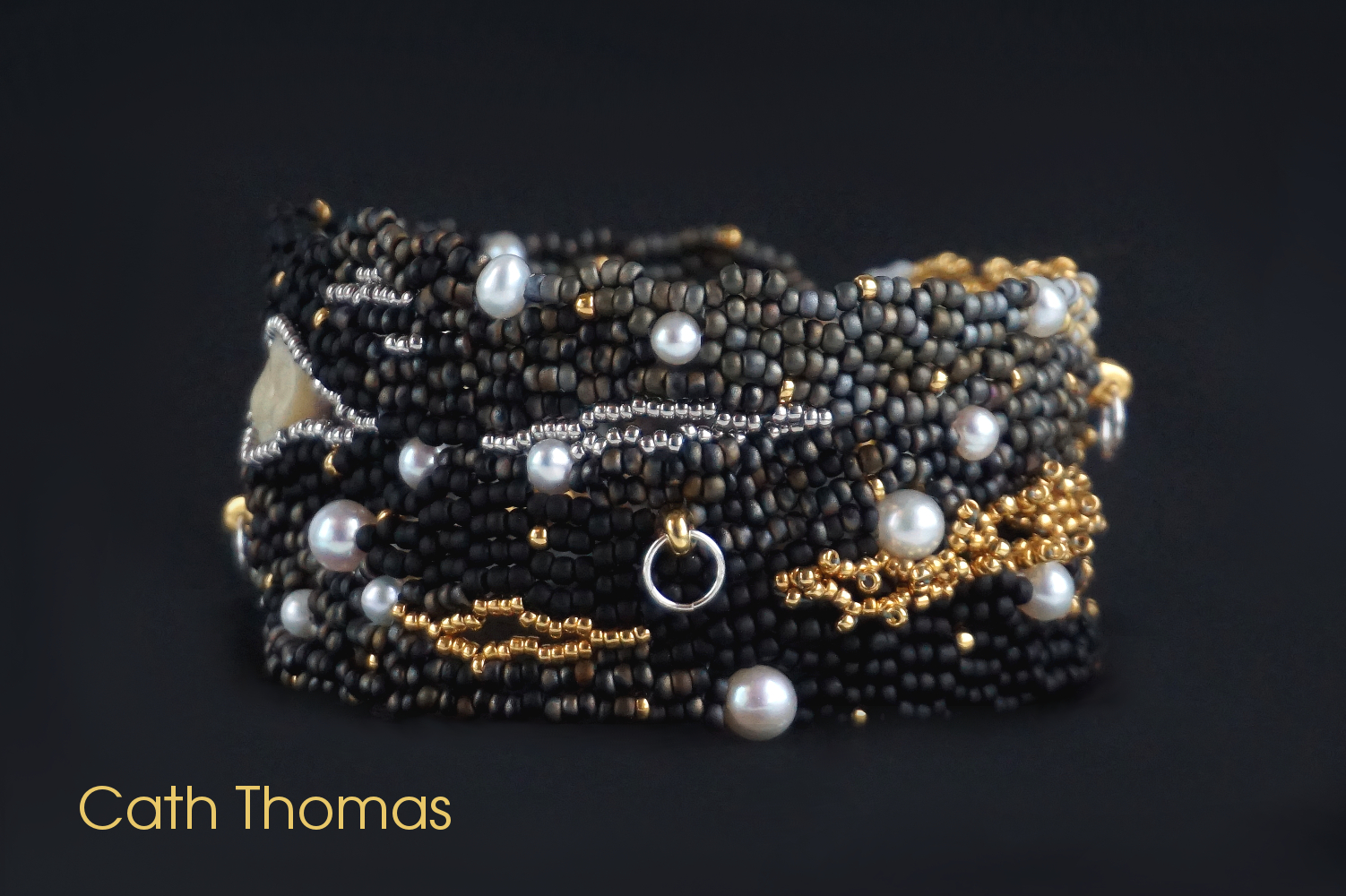
Last but not least, this is the text I wrote on Facebook when posting the photos of my 'Silver Lining' bracelet there. Learn more about this cuff.

What is sacred?

Everything.

Life is sacred.


The birds, the fish, the dragonfly, the pangolin, the big and the small cats, the apes. the trees, the moon, the sun, the stars, the entire Universe. Your life. Your body. Your soul. Everyone's life, body, soul.

Love is sacred.

The love in your heart is sacred. Even the sorrow in your heart is, for sorrow is linked to love that is not acknowledged, may it be because of absence or departure...

Time is sacred.

Your time. Everyone's time. Because life is time.
Your feelings. For feelings come from love or the lack of it.

Your eyes telling how you feel. My eyes. Theirs. Your eyes seeing life unfold. Our eyes seeing miracles happen. Miracles of life, miracles of love.

And all this echoes with that light that you have inside of you, that light that has no name, that light that shines or sometimes dims...

The time you are not gazing at the moon, not holding a kid's hand, not laughing with friends, not making love - maybe because you can't, but still need to put all that love into something to keep that light shine on, is sacred. Maybe just to say to whomever will see it that you exist, with all this love or light inside of you that you don't know what to do with... To say that you are life, still alive, also there, also a part of it all. To be acknowledged.

And so the things in which you put all that time, all that love, a little bit of your soul, making it meaningful things, are sacred. By extension.

And so, everything becomes sacred.

Everything is sacred.


Saturday, December 22, 2018

Kitsugi-inspired freeform peyote

I discovered freeform peyote and bead embroidery nearly at the same time. I was completely fascinated by Tina Koyama's and Lillian Todaro's beautiful beadwork.

I have never learned it from a teacher, or book and was a bit lost, but managed to make 2 necklaces.with bead embroidery and freeform straps. Both are dating back to 2006. One is called Atoll, inspired by the beautiful photography "Eye of the Maldives" by Yann Arthus-Bertrand, and the other is called BaBe ('Baah-Bay') - formed by 3 rivers, in Vietnam. Babe means 3 lakes, but it forms only one nowadays, due to all the sediments that have filled the bottom of these 3.

'Atoll'
'Babe'

Although I love the result very much, they are far from perfect, and I wanted to learn more beadweaving techniques before tackling this type of beadwork again. I got hooked on Cellini peyote, and geometric beading, but I knew that I would come back to freeform one day. 

I made progress and created many designs. One day, I dreamt of another, entirely freeform beadwoven necklace, called Liquid Earth. In that dream I offered it to sha-woman Keisha Crowther, aka Little Grandmother and founder of the Tribe of Many Colors. Keisha is a protector of Mother Earth and healer. I respect her work tremendously, and so I made it, and sent it to her.


'Liquid Earth'

Last Summer, I decided to offer a workshop to other persons who are also struggling with health issues, in collaboration with our common ergotherapist.

I decided to teach them peyote, and a freeform ring, and see what would happen. To prepare myself for this class, get my hands back at freeform peyote and have an example to show to them of what can be made with the technique I taught them, I made this 'River' bracelet and ring. 

'River'
'River' - upside down

River has a double glass button clasp.

'River' - ring
I was  pretty happy with the result. And my students were happy with theirs. And now I am in search of a place where to continue the adventure of beading all together. My ergotherapist herself is hooked too, and helping me. She will arrange for another place to visit in February, which is not soon enough, but alas, at least there is hope! And it is so close to my home that I should be able to go there by foot. Please, cross your fingers for me!
 

Now, after completing this piece, I decided to go for a special freeform peyote cuff, inspired by the art of Kitsugi, which is the art of repairing cracks in broken pottery by adding gold to focus the attention on the breach, and the story behind it. To make an item that was already something dear to our heart a piece of art, with more significance. 

I have been wanting to create a cuff like this since a long time. With beautiful materials.


My goal was to make an allegory of a walk of life, with its moments of darkness and light...
with stellar people met, and key moments, be they good or bad, and light passing through all the cracks.

I let my needle and beads take some initiatives and ...

it ended up becoming the Universe... Initially, moon and sun were not meant to be there (and finding the sun button was quite challenging), but the piece simply called for both to be there. 


Also, the moon, reversible, is black on the other side, which allows me to wear it with its bright or dark side to the front.

'Silver Lining' - precious metal seed beads, freshwater pearls, sterling silver
findings, a glass moon bead and a gold plated metallic sun button.

Apparently, when I do freeform, my love for nature makes me create landscapes of all sorts.

There are lots of tutorials and explanations out there to do freeform peyote. I hope that you will give it a try. It is very liberating!

Sunday, November 11, 2018

Where is, where are? How I store my finished beadwork.

Perhaps you remember my article "Bead Organized" about storage and organizers for beads, trays, tools and boxes with cabs and findings?
Did you notice that something very important was missing? Yes! Finished Jewelry Storage. Let's call it FJS.

Nice "psyche"
It was missing because I hadn't found the right solution for me. I had boxes full of beadwork on my shelves. There were bags with things I had completely forgotten about... and that was simply not OK.

When you love beading, chances are that you have a growing pile of beautiful things. And even if you sell and/or offer what you make to others, there are certainly plenty of things you want to keep. Maybe you have a wonderful FJS. If so, I would love to receive photos of it to add to this article. I know, however, that some have their beadwork piled up in boxes in which it ends up entangled. I have many pieces in boxes too, but to avoid the entangling part, I put everything in separate plastic bags. It is particularly useful for jewelry sets: it all remains together and nothing gets lost.

In an ideal world, I would showcase my most special pieces on shelves behind glass, and have a vanity with lots of storage space, but as for many, my world is not perfect. My apartment is small and some places tend to be invaded by what I wear most regularly, or by recently finished beadwork that I don't want to put in a box immediately... Thinking about it - I made many new pieces the past year:

One year of beading (Oct. 2017 - Oct. 2018)

I saw several lovely "Psyche" out there, as the French call them, but although I quite like them, I find that they take too much space on the ground and the price was a little high. My big pieces would also not fit in there. The only place where the storage could be added was a spot between my bedside and the window. I have been searching for a satisfying solution during months, without success.

Now this article might seem to be about what you could do, but it is actually more about something to avoid, and that is buying plastic hooks like the ones in the photo left. 3 sizes, perfect for necklaces, rings, objects like brooches, and for earrings. Super cheap, they come in multi-packs. After some hesitation, I bought a shallow Billy shelf, in which I placed these practical hooks with double-sided tape and thought that I had found the best possible FJS I could dream of. I even made lots of photos of how I arranged everything... but... as said, the world is not ideal and my plan didn't work as I hoped. The tape and the lacquer, or whatever it is, on the Billy, didn't really like one another. During the night following my installation, all the crochets came off. Needless to say that we didn't sleep super well - the hubby freaked out when the first things fell... in the end there was so much beadwork on the bottom shelf, that the last pieces barely made a sound when falling. Only the earrings, light weight, remained in place.


Yes, beads are heavy and just like bead storage, beadwork storage has to be sturdy too! I thought about attaching it all with screws... but preferred buying peg boards with assorted hooks which I can move freely, tiny shelves and elastic cord which offer the perfect support for earrings, necklaces and bracelets. Unfortunately, this resulted in costing a bit more than foreseen. What I use less is in sturdy boxes, with stickers mentioning what is in there, so now I know where my CGB beadwork is, or tutorial beadwork, or contest beadwork, There is a  box for "specials", etc. So here is my FJS. It takes only 40x28cm on the ground but is 2 meters high and holds everything I want.

The bracelets are on a support that is normally meant for house-hold paper.
The tiny shelves are metal, and so magnets stay very well on them.

I cannot say that this is my dream FJS - the back of a Billy shelf is not so sturdy... but so far it  stays put and is very practical. Now if you wish to create this shallow storage with peg boards (called Skadis), unless you are really handy yourself... you might need an ingredient that might be hard to find: a handy hubby. And I would like to take this opportunity to thank my dear one for cutting the peg board and fixing it and also for the many other things he does. Love him b

My next buy might be a mirror that can open and close thanks to hinges at the back. They mention that one can add small objects at the back of the mirror where the crochets for screws are not in use. What I would do is hang my favorite pendants and earrings against the wall and close the mirror to hide it all! Hop! On my wish list for x-mas!

Now if I could find more hands to help me rip out old stuff to ⥀... but that is another story.  

I hope that this inspires you. Thank you for reading me! Maybe you also will like to bead with me?

Use coupon code CATHELIER to get 25% off of all patterns - valid only on my website until 30.11.2018 (not on Etsy). 

Happy Beading!

Cath