Showing posts with label inspiration. Show all posts

Wednesday, September 23, 2020

Beadworker's Guild Challenge 2020: Fantasy

I wrote a very long article about my entry in the Beadworkers Guild 2020 Challenge before the pandemic breakout and when post-poning its publication, a Google "glitch" erased it. Argh! It was a long article with so many details and information and photos and corrections and updates, that it destroyed my writer's mojo for a while...

Fortunately, the very long wait for the judging to take place gave me enough time to write up something detailed again. I am crazy happy with my submission and was sitting on hot coals during months - most of you understand how hard it is to not be able to show what we are making with our beloved tiny little beads.

This year's Beadworker's Guild Challenge theme was

Fantasy

Neuschwanstein Castle, in Germany built for King
Ludwig II who loved legends and fairytales.
Walt Disney based its Magic Kingdom on it,
as well as Games of Thrones their Eyrie castle.
I love this castle.

Fortunately, I talked with our BWG newsletter editor Karen Gibson-Brown, because I couldn't help but thinking of fairy tales, in particular Disney.

My Tinkerbell. Entirely
made with "petals"

Disney's work is protected. Of course as long as one doesn't sell tutorials or multiple drawings of the Ice Queen made by the kids, there is no problem with a kid drawing Ice Queens (or Cinderellas). Or a beader beading Tinkerbell.

Karen clarified that it actually was quite a vast subject. After searching for more information about it, I came to find it analogous to "Mental Screen". Fantasy is what we can see in our head thanks to our imagination.

I find it fascinating how a fantasy creature can become so "real". It seems to me that with another pair of shoes or dress, or hair color, my Tink wouldn't be the "real" Tink anymore. Some things enter our mental screen and cannot be unseen anymore.

There are many myths and tales, but of course, for this challenge I had to come up with something "me", and make my submission worth the "previous winners" category. (You can read the article about my previous win with Nefertum's Wesekh here.)

I have too many flasks
of E.O. to fit in this box.
Early in 2019 I had ordered a 32-slot wooden box (for essential oils) for my husband's collection of tiny aquarium test bottles. Once inside, it was impossible to read the labels... The question "what to do with it now" got an unexpected answer from my muse, Eddie: "Put your chess play in it when you finish it"...

Huh ??? my chess play?! Naaah.... I counted the slots,  was stunned, but.... a project initiated in 2013 and quickly abandoned because time and motivation were never there at the same time?

Decisive move by Ron Weasley in Harry Potter and
the Philosopher's Stone. I love the Harry Potter Saga and I like chess.
Did you know that the modest yet determined and
brave pawn can become what ever it wants?

Eddie insisted: « Let's do this! Beading for the BWG challenge has to be challenging and you’ve always wanted to make it! Plus - oh la laaa - it is perfect for the Fantasy theme. » I had to agree. To play chess, one certainly needs to have serious mental screen "skills"; strategy asks for imagination. And each battle is a fantasy battle. I couldn't get it out of my head anymore. So I gave in, started it all over  and...

Tadam!

Friendly family picture

All on the "board" for a fantasy fight.


Inspiration and Techniques

Before I explain the making of this wonderful yet crazy project, I would like to credit Debra Schwartz (aka Datz Katz Designs) for her influence. She had made a pair of earrings called "Spinnerz" (published in Contemporary Geometric Beadwork vol. II) and during one of our messenger chats, she fantasized about all the other things she could make with her wings built on a CRAW core.

Photo of the Spinnerz in CGB vol. 2

When she mentioned a chess play, my muse immediately got hyperactive. Lots of ideas popped up. She showed me some sketches but I already envisioned the pieces my way, with shaped Czech beads to spice them up. We imagined making both half of a play with the wings based on the CRAW core for the core architecture. We both realized pretty quickly that we had way too many other things asking for attention. 6 years later, I asked Debra for her permission to make and enter my chess play in the BWG challenge and she kindly agreed. And even if it is different from what she envisioned, I absolutely want to credit and thank her for the inspiration and for letting me use her Spinnerz as the base for my chess play.

I think that it's good that I waited so long before really taking up the chess project. As a much better beader than in 2013, I enjoyed the actual beading and designing process much more, even if I encountered numerous difficulties not mentioned in this article! There are even things that I would not have been able to make back then, in particular little Olaf.

Although the pieces are based on an MRAW start with RAW and PRAW cores, it is a really cool geometric peyote exercise. I used petals (a 2-increase shape of my own find) for the gowns and the fish, and triangles - some equilateral, some elongated - and a variety of pear shapes for wings (as in my Tiny Tulip  and Diane Fitzgerald's Radiance pendant.

I used a square base for the pawns, a pentagon base for the towers, knights and bishops, and a hexagon base for the queens and the kings.

One discarded pawn displaying
typical medieval retaining walls


My first pieces were the bishop and the pawn. The latter remained on my designing board during months. I made many, many versions of the pawn before finding the right head for it. Interestingly, all versions had something "medieval" about them.

Only after finding what I would do for the king's head, I knew what to do for the pawns, and that was adding a crystal chaton in a gold-plated setting. I also added crystal chatons to the queen's gown and as eyes of two knights.


I gave the bishops and kings a cape, which can either float or be wrapped around their body. I like to shape them to give each piece a different look.

I imagine kings and counselors standing on a hill,  looking
far in the distance, with their capes floating in the wind.

While making the kings, I couldn't resist thinking
of the Argonath in the Lord of the Rings.
I love the Lord of the Rings saga.

Materials


Delicas 11° in two different opaque light cream, matte 24Kt gold-plated and matte and shiny black;
Miyuki opaque size 15° black and egg shell;
Miyuki opaque bugle beads size 3, black and ivory luster;
Toho Starlight in sizes 15° and 11° and 8°;
Cube beads for the base of each piece;
Pearls ranging from 2mm to 10mm are present on and/or in most pieces;
KO black and KO gold thread - the gold conferes an antique ivory look to the "whites";
Glass cabs and felted pads.

I also used Gumdrop beads for the bishops' mitres, Tile beads as drawbridges for the towers, Superduo beads as drawstrings on the ladies' gowns, Spike beads for the knights' unicorns and large Magatama beads for the serpent's scales. Most of the cream beads are called champagne in catalogues.


A large pearl at the top of the towers mimices the dome of an old astronomy observatory. It shows better in the video.


Same shape, different fold


The most special aspect of the play is that the black pieces can be seen through, not the whites. They are rigourously the same, with exactly the same number of beads, but their wings are joined the opposite way. This shows best in the pawns. 

 As a result, they are very similar, yet all different.

The black pieces have rigorously the same bead count as their white counterpart, but the wings are joined differently. 


For the gowns of the queens, I pushed the white petals half inside out and left the black fully concave.

The 4 knights are unicorns, with heads based on my Tiny Tulip design, shaped and embellished differently, resulting in small (serpent), medium (bird), large (fish) and extra-large (bat) heads.


The bat and the bird can spread their wings and the serpent can move its head and adopt quite a variety of postures. They fit well in the box (but they seem to be willing to jump out of it at any time).
The fish can only move its tail and fins a little bit. Or rather, I can move them...

Ever since I saw the Harry Potter chess battle, my mental screen sees things 😃. 


I've always wanted to make a "fins over head" fish as, for example, in Bernini's fountain (The Triton Fountain in Rome, below left) and some Asian koi sculptures. When my fish Olaf (below right) started sleeping in this  position, it became a must.


The bird is inspired by my zebra finches, in particular Figaro, the fastest flyer of the flock, very hard to catch. It doesn't show in the photo below, but he is very chatty too.

Figaro, Fluff de Puff, and Fiora


The Board


I dare to think that the "board" is ubercool, for it matches any home decor, thanks to the "whites" being the color of the furniture, here a recycled mango wood table.

 
The squares are all made with a full octogon Diamond Weave stitch with thread cover beads, resulting in a traditional clover motif. I wanted something reminding of ancient floor tiles. The ivory border is made with the same stitch. It has a lot in common with the Chinese coin motif stitch. 


I made lots of different squares before I chose the above tile. When I realized that it would become a fractal eg. mini boards forming one large board, I knew that it was the right one.


 A lot of thread was used...


Beyond Beading


The bottom of each finished piece is filled with a glass cabochon, to which a self-adhesive felted pad was added.


Husbest sanded the box for me (I am really bad with wood - if there is one splinter, I will "find" it...), but I smeared it twice with natural antiquaire's wax, which smells amazing, to protect the wood, and give it a nice, natural color. I dislike varnish, because it turns yellow over time, which doesn't happen with real wax.


A bronze closure and embellishments were then added to the box, including 4 legs which look like animal feet. I tried a variety of legs, and made photos before choosing the preferred ones. Here again, to not screw the whole thing up, the help of the husbest was a must, and much appreciated.


Finally, I hand-sew a little poach for the board to which I added 2 cord ends inspired by the pawn heads.


And before sending it all to the UK, I had fun playing with it...


... and I made a video to show everything better. A dear friend edited it for me and added some music composed by him, for free and I hereby thank him VERY much for his time and generosity!


 I hope that you will find it inspiring.
 
Thank you very much for reading this far, watching and commenting!!

Cath


Saturday, December 22, 2018

Kitsugi-inspired freeform peyote

I discovered freeform peyote and bead embroidery nearly at the same time. I was completely fascinated by Tina Koyama's and Lillian Todaro's beautiful beadwork.

I have never learned it from a teacher, or book and was a bit lost, but managed to make 2 necklaces.with bead embroidery and freeform straps. Both are dating back to 2006. One is called Atoll, inspired by the beautiful photography "Eye of the Maldives" by Yann Arthus-Bertrand, and the other is called BaBe ('Baah-Bay') - formed by 3 rivers, in Vietnam. Babe means 3 lakes, but it forms only one nowadays, due to all the sediments that have filled the bottom of these 3.

'Atoll'
'Babe'

Although I love the result very much, they are far from perfect, and I wanted to learn more beadweaving techniques before tackling this type of beadwork again. I got hooked on Cellini peyote, and geometric beading, but I knew that I would come back to freeform one day. 

I made progress and created many designs. One day, I dreamt of another, entirely freeform beadwoven necklace, called Liquid Earth. In that dream I offered it to sha-woman Keisha Crowther, aka Little Grandmother and founder of the Tribe of Many Colors. Keisha is a protector of Mother Earth and healer. I respect her work tremendously, and so I made it, and sent it to her.


'Liquid Earth'

Last Summer, I decided to offer a workshop to other persons who are also struggling with health issues, in collaboration with our common ergotherapist.

I decided to teach them peyote, and a freeform ring, and see what would happen. To prepare myself for this class, get my hands back at freeform peyote and have an example to show to them of what can be made with the technique I taught them, I made this 'River' bracelet and ring. 

'River'
'River' - upside down

River has a double glass button clasp.

'River' - ring
I was  pretty happy with the result. And my students were happy with theirs. And now I am in search of a place where to continue the adventure of beading all together. My ergotherapist herself is hooked too, and helping me. She will arrange for another place to visit in February, which is not soon enough, but alas, at least there is hope! And it is so close to my home that I should be able to go there by foot. Please, cross your fingers for me!
 

Now, after completing this piece, I decided to go for a special freeform peyote cuff, inspired by the art of Kitsugi, which is the art of repairing cracks in broken pottery by adding gold to focus the attention on the breach, and the story behind it. To make an item that was already something dear to our heart a piece of art, with more significance. 

I have been wanting to create a cuff like this since a long time. With beautiful materials.


My goal was to make an allegory of a walk of life, with its moments of darkness and light...
with stellar people met, and key moments, be they good or bad, and light passing through all the cracks.

I let my needle and beads take some initiatives and ...

it ended up becoming the Universe... Initially, moon and sun were not meant to be there (and finding the sun button was quite challenging), but the piece simply called for both to be there. 


Also, the moon, reversible, is black on the other side, which allows me to wear it with its bright or dark side to the front.

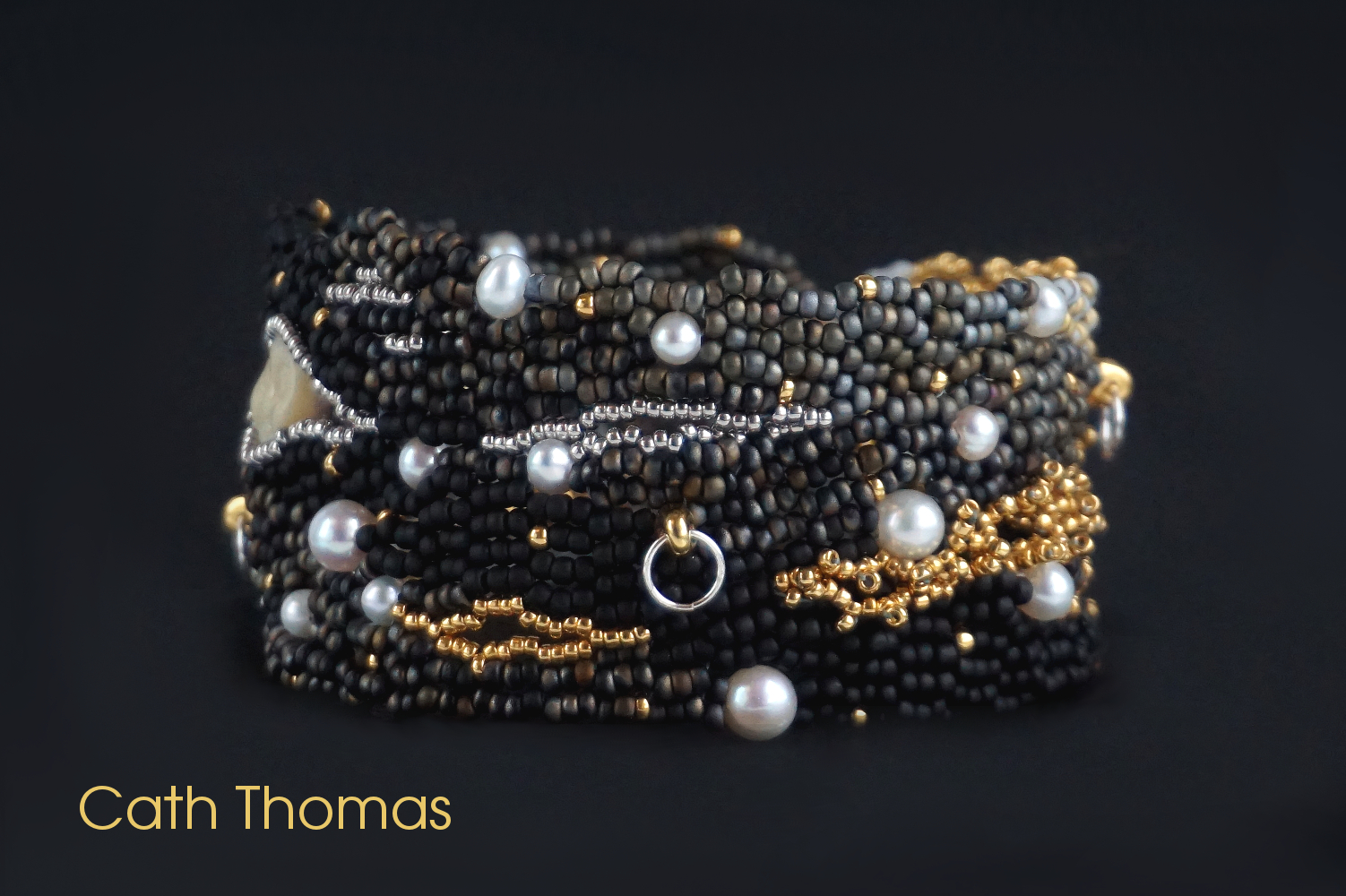
'Silver Lining' - precious metal seed beads, freshwater pearls, sterling silver
findings, a glass moon bead and a gold plated metallic sun button.

Apparently, when I do freeform, my love for nature makes me create landscapes of all sorts.

There are lots of tutorials and explanations out there to do freeform peyote. I hope that you will give it a try. It is very liberating!

Wednesday, May 30, 2018

Perfumes and Pomanders

The past months, I have not only beaded and tutified a lot, as you may have understood from my previous post; I have also, somehow,  made an old dream come true.

Precious Pomanders is the easiest design in my series with
dimensional Cellini peyote with flames start
I must have been about 15 when I met with the father of one of my brother's good friends. The man was a nose for the firm Firmenich in Geneva. Ah! creating fragrances - how divine! Of course, I wanted to do that too. My mom seemed not so enthusiastic about it, but during the "professional orientation" meetings which were organized by the Department of Education of the canton, I asked to meet with translators (my other option), and with people working at one of the (still now) major producers of perfumes and fragrances in Geneva, Firmenich or Givaudan.

Together with 2 other students the visit took place at Firmenich. We saw the old labs and facilities (not so attractive, actually), where thousands of graduated phials and other mysterious materials were on display. We also briefly visited the administrative building, where we took a Paternoster, which was an event on its own. This is a Paternoster:


Although it might have been a great way to test people's reactions, or wake them up enough to do a good job (and not blow the lab up with a silly chemical reaction), the dangerous thing has been removed because accidents ought to be avoided everywhere, of course. But I loved it. Being a monkey in Chinese astrology must mean something: as a kid I climbed on every metallic structure when there was one on a play ground and, older, even crawled from one balcony to the other on 3rd floor one day, so this was peanuts.

"Nose" working at an impressive perfume organ
Working in a lab didn't seem very attractive (I don't remember seeing their perfume organs, which was somewhat disappointing), but sitting in a little box as a translator even less, so I already saw myself enter Firmenich for an apprenticeship and was super motivated. Chemistry became my best subject. I loved experimenting and collected miniatures of all perfumes that hit the market.


My first favorite fragrance

Sadly, I did not become a nose, but not because of my nose...
I became an administrative assistant. This was not bad at all, in particular in the pharmaceutical branch and even more the International Union for Conservation of Nature, where infrastructure was/still is very good, but when a book  like "the Perfume" - and later the film- came out, my heart reminded me of my old dream. Fortunately, a visit to the parfumerie and a new flask of Eau de toilette in my bag did somewhat the trick.

Perfume can make you feel better in many ways. It should lift your spirits, makes you feel a stronger, more beautiful you, bring self-confidence. If it doesn't, you haven't chosen the right one. Also, you shouldn't smell much of it yourself. That is the hard thing with a well-chosen perfume: you nearly won't smell it yourself, because it is very much "you". It should feel like an invisible veil magnifying your charms. You won't notice it much, but others sure will. If you smell it yourself, it is either not the right scent, or you put on way too much.


My last bottle of The Beat "died" not long before last Christmas, so I decided to find a new favorite scent, something I had smelled earlier on somebody, "Sì" by Giorgio Armani.

A good perfume should feel like an invisible veil
magnifying your charms, but should not contain
phtalates and other dangerous ingredients.
Fact is: they nearly all do
Delicious, but... perfume can also make people feel really bad. My poor husband had a terrible
 reaction to it and got really sick, and even I felt that something was wrong with it. Browsing the web we discovered that there are many allergic people and that many perfumes are just a big mix of chemical poisons.

Because perfumes always have to be the same, producers rely on chemical essences (artificial scents) to always recreate perfectly the same fragrance. Natural products always differ from one batch to another, due to the weather, soil, temperature and maturity of a plant at harvesting time, etc... I've noticed that essential oils, like eucalyptus, can differ quite a bit depending on the batch, producer, year, geography... Of course, there are chemical products that are harmless, and there are natural products that can provoke skin reactions.

I decided to find out more about perfumes made with essential oils and to go for what I know I can eat. I first searched for matching aromas present in my favorite brands over the past years and wasn't surprised to find several common ingredients, like bergamot, vanilla and mandarin (and always jasmine too, but that is most certainly a culprit for my hubby's allergic reaction, seeing that he can't even bear natural jasmine flowers or alike).

I ordered some oils and extracts - all high quality, organic products, played with them like a real pro - with blotters and all, and...  created a scent that makes me happy. My perfume is a fruity and slightly spicy scent with vanilla, bergamot, rose petals, cardamom and pear, all things that are edible... It smells very good, and it doesn't make my husband sick. Hurray! Also, each time I work with my oils, I feel immediately better, in particular emotionally.

Nicolas Neufchâtel - Portrait of a Woman
holding a Pomander - Detail
Confident that it wouldn't harm the best man in the world, I could finally make what I had planned to make with my dimensional Cellini peyote baubles: Precious Pomanders.

Pomanders are so delightful! Precursors of modern aromatherapy, their name comes from "pomme d'ambre" (Amber apples in French). Very popular during the plague at the end of the Middle Ages, these balls filled with herbs, preserved in a wax-like substance, worn around the neck, wrist, or waist, rapidly became the ultimate accessory jewelry among the wealthy. It can often be seen in portraits, worn by people (men and women) who believed in nearly magic protection. This protection was actually somewhat correct, seeing that many plants have antiseptic properties. Learn more in this interesting article about pomanders, and discover an ancient recipe by Nostradamus, who was primarily a doctor and apothecary, and way ahead of his time in the field of phytotherapy and hygiene, and maybe the reason why Catherine of Medici lived pretty long in those hazardous times.

Pomanders are very practical for people who avoid perfume on their skin, or like to change scent without fear of interactions between two different ones.

A wonderful present: this Orchid Pomander
with May Rose Petals scent is truly heavenly
Glass beads offer enough of a barrier between the oils and the skin, but let the scent emanate well, so a beaded pomander could only be a good idea. All I needed to find was a carrier bead. Not one supporting the bead work to give it a shape, but a bead to carry the oils. I found back colorful felt balls in my drawers, which appear to be perfect for this. Two drops of E.O. per bead are more than enough. I let the beads cure in a glass container, so that the volatile essences went inside the bead. A few days sufficed for the felt beads, which are very porous, but a couple of weeks in the jar would be better for wooden beads.

The fragrance can easily be renewed by adding a drop of oil to the carrier bead through the slits on the side of the pomander. The same scent as the one before should be used.

Tip: you can match the colors of beads with the fragrance - like purple for lavender, red or rose for roses, etc.

I don't know if the oils will affect the coating of the beads in some way. So far everything is fine, but it probably depends a lot on what oils are used. But I can always bead another pomander and change oils. I imagine making them in yellow for lemon, bergamot or vanilla, orange for mandarin, oranges, and cinnamon, maybe a green one with peppermint and eucalyptus,... purple... pink... red... yum. One for every occasion.

Precious Pomander with harmony ball
on long, soft Chirmen cord


In my previous blog post, you may have read that I put a "musical bead" in the fruit punch & gold pomander. It is also called harmony ball or Mexican bola, and is often worn by pregnant women on very long chains or cords so that the ball itself rests on the belly button. It is said that as of 16-20 weeks, the unborn baby will hear the soft chimes sound coming from the harmony ball. The sound is said to soothe the unborn baby and can even have calming benefits for the mother to be. Personally, the sound makes me think of magic and I simply love to play with it. But the baby will remember the sound heard in the safe mother's protecting womb, and that will help him or her soothe when feeling discomfort or stress after birth.

The pomander can also be beautiful bauble for Christmas decorations, or a precious napkin ring if the points are left open. All this is explained in the tutorial.

Thank  you for reading this long post! Please leave a comment below - I love to hear from you.

Cath