Friday, May 13, 2022

Beadworkers Guild Challenge 2022 - Hollywood or Bollywood? Hollywood AND Bollywood!

Warning! Long blog post! Read it when you have a moment to relax, and laugh of my "tribulation  report" :D
 
Now that it has been revealed, I can finally talk about my make for the Beadworkers Guild yearly challenge. Clearly, not one of my BWG challenge beading and planning processes are the same. First time - for the Egypt themed Wesekh, I had everything I needed in my stash, and made the clasp myself. The next year, I made my Fantasy chess play so it was easy to choose the right colours, although "ivory" is not the same from one brand to the other, and the Czech shaped beads are called "champagne". Past year, I recycled a sculpted bird to create "Peace, astray" because the theme required us to recycle, and evidently this resulted in using beads from stash again.

The only things in common are long hours of work, and the fact that the view of my beading mat would result in some of my beading friends needing extra oxygen or maybe even defibrilation.

This year...
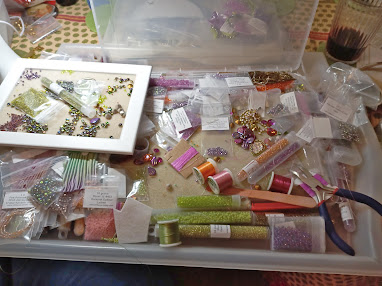
It doesn't show, but I somewhat succeeded to organize my capharnaum: I piled up 3 boards to 'contain' the colour studies and swatches, instead of everything on the same mat. It was a bit acrobatic, but in the end it paid: I needed less time to tidy things than for the previous projects. I nevertheless told my husbest that I need more space (I'll let you imagine his face, haha).

Decisions, decisions

Theme Interpretation
 
Never before did I hesitate so much in making decisions as for this challenge. I had my very own idea right from the start, but studied a bit before going for it.

Reading this article about the exceptional collection of costume jewellery created by Joseff of Hollywood for films and stars didn't help, but it was wonderful to see all the stuff made for Hollywood's big films and stars over the past century.

Bollywood films, which often show beautiful Kundan jewellery worn by gorgeous actresses in full wedding attire also didn't help. I love it. But didn't want to copy it. Reminiscent of Rajastani royalty, Kundan is the name for the ancient Indian art of stone setting. It dates back to the 3rd century. Isn't that humbling? The craftmanship is amazing, and so clever. Have a look when time allows:


The theme really had me think. I didn't want to make an Indian wedding regalia, which shouts "Maharani" to me; or a piece for a Queen (Victoria or another), it would become an historical/royal theme and, well... for Cleopatra I already have a Wesekh (made for the Egypt-themed challenge). 

What did help, was what Karen Gibson-Brown wrote in the May/June newsletter: "For this challenge will you choose to rub shoulders with ‘A listers’ on the red carpet of the Hollywood Oscars or will you be heading to the land of sumptuous silks, spices and Bollywood musicals or, will you choose a mix of East meets West ?"
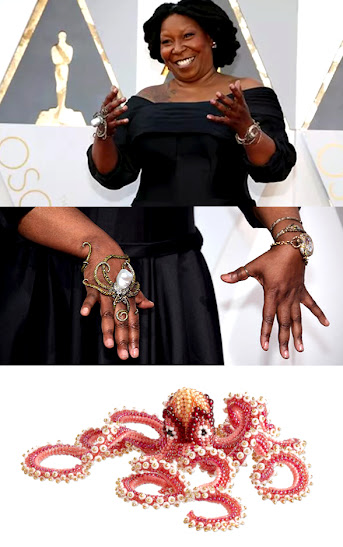
Nowadays movie stars mostly wear jewellery lent by jewellers and sometimes it is absolutely fabulous, like the octopus hand adornment "Kraken"created by Turkish designer Bıçakçı, sported by Whoopi Goldberg at the oscars back in 2016. Inspired by Jules Verne's underwater fiction, it is not only fabulous, but also makes her look fabulous. Look how she shines! And obviously, she stole the show. 

Why do actresses wear jewellery? To be noticed. Why do Jewellers lend their jewellery? To be noticed!

As said, I had an idea already, and that was to make something an actress would want to wear on a red carpet at the Oscars or Golden Globes to stand out of the crowd - like Whoopi, or an Indian actress in Mumbai.

So I decided to create a shoulder adornment, an Epaulette. 

Something ravishingly lacy, layered. extravagant...
 

Thetis's Epaulette - BWG 2022 challenge "Hollywood or Bollywood"

Something that would drape from the shoulder down, like saris drape on one shoulder, with rich texture and depth.


Something that would gently dance while moving.
 
 
Something to go with my purple  dress...
 
Ear clip and ear hook
 
 
A matching ear hook (self-made hook) and an ear clip complete the set. The ear hook is for the left ear, and the epaulette is for the right shoulder (because it is made for a purple cross-over dress, which crosses right over left). Of course, I first made it all the wrong way because saris are mostly worn with the fabric draping down the left shoulder, so I did as much "frog stitching" as I did Saint-Petersburg stich! A real lot!
 

Making of this set
 
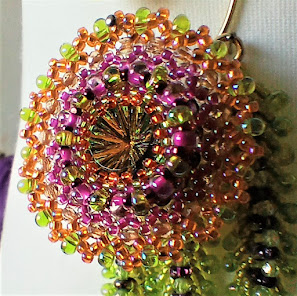
I had to push technique beyond boundaries and give in when the beads dictated their rules. It decided to live its own life early on, developing a unique "marine life" look. I love the wet sea weed look and the depth of the German cabochons, which is incredible.
 
Close-up of ear clip with the hook behind it
 

The colours

This year my muse litterally disappeared when it came to choosing colours, and I hesitated a long time between Hollywood (glamorous gold and diamonds) and Bollywood (bright colours). I don't dare to  sum it all up but I severely exploded the budget, because I bought a lot of beads and more beads after making swatches and changing my mind. Here again, the May/June Newsletter was helpful, although I didn't realize that back when I read it: in this newsletter the colours of BWG booth were announced, Fuchsia and Lime. After a serious fight with the muse, I decided to use these colours rather than the glamorous gold (which my muse still pesters me with, even now that the challenge is over) AND orange for marigold, because in India, you see these flowers everywhere.


Focal with lacy corrolla

 Designing

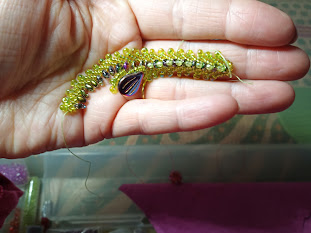
It looks so simple but was hard. It needed a lot of thought, problem solving and adapting (letting go) process. That is what happens when you have an idea (the feathers) but beads want things differently. 


The feathers/sea weed needed 2,5mm fire polished beads! The 2mm and 3mm that I bought were useless because the feathers would curve in or out, resulting in a very unwelcome swirl. It  was hard to find those rare little glistening beauties in the right colours. The true2 has provoked less interest in the 2,5,mm and that is a pity, because they're really perfect. I found lovely colors at Jencel Beads, but she could not send them to Switzerland and I had to ask a friend in the UK if she'd agree to send the parcel to me as a gift.

Drop and fire polished beads addition
 
Technical struggles (self-challenges)
 
No matter how well I controlled my thread tension, the feathers still slightly turn in the direction of the first row. It is not obvious, but enough to not ignore, so I beaded in mirror half of the feathers.
 

"Thread management" needs improvement
 
 
To add so many beads around the cabochons to obtain a lacy corrolla without ruffles was also challenging. I wanted to add lots of beads, colour and layers. I used netting, Huichol, and had to come up with some sort of "back and forth lacy stitch" to get things straight (and started over many times). Diamond Weave was not part of the work this time, but knowing it helped quite a bit. 

First layers of lace wanting to ruffle, of course!

 
Colour placement
 
The German cabochon shows exactly the colors that I used - green, fuchsia, orange and orchid. It has amazing depth. Interestingly, it also had a blue sheen in it which disappeared once the stone was bezeled. I made  many colour swatches. It was not so much "which colour" anymore, but rather "where to place this and that one. It is impressive how some colors side by side can "kill" or turn other colours dull. 
 
 
Thread and weight hassle
 
The Twin beads and engraved pip beads not only had sharp holes, but their weight all together was quite impressive. Thread broke. Repairs were made. Solutions needed. I would have loved to make a more exuberant piece, with longer sea weed (which was planned), but I quickly wondered how on earth it would remain in place on a shoulder. The words "Nobody will want to wear this" resounded in my head (aka the muse shouting at me)...  Well, "earth" was the answer: I used "rare-earth" magnets, ultra-thin yet super strong discs. It will stay in place even on a jacket with these! But of course, when I received the first lot, they were too weak, and I had to place an order for stronger magnets, reason why my parcel left for the UK only on 21 March, very close to the deadline!!!
 
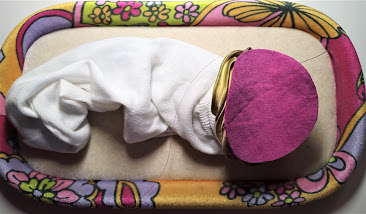
To add the leather to the back of the epaulette,
I used a sock to keep the weeds out of the way of the thread.


Extra challenge

I am not a Shibori silk person so this was a great occasion to play with the delightful yet dreaded (by me) fabric. It offers a perfect base, nothing too overwhelming or bright, yet soft, luxurious and delicate (in a fragile sense). You'd think that I could have been braver with this base. Well, initially I thought about embroidering a soft foam epaulette. It had to be easy on and off, which it wasn't, and comfy to wear. It did not offer the look I wanted either. So it is round and domed, backed with leather, and quite the perfect support for the sea weed that pulled so much on the threads. Also, I am very proud of the beaded edges.
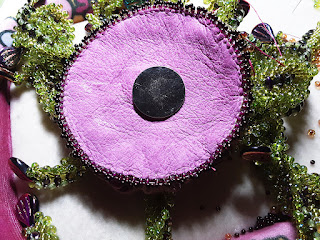

 
Magnets before and after adding leather

The little details
 
Even though the piece seems relatively medium sized, to have everything in the right place, varying lengths of the sea weed, drops at different distances from the top, no ruffles, no gaps, etc. was a very complex designing experience. Even the joins between the pad and the weeds (the edging), necesary to keep everything in place and reduce thread sollicitation in the corrolla, are equidistanced. No threads showing. Etc. I started several things over because of just a tiny little detail. Because details matter for a challenge like this.


The photo above is terrible, but you can tell that I'm really happy with it. It has harmony, movement, depth, and smooth sophistication. And the perfect "wet look" thanks to the use of soft glistening drop beads. It is a real jewel in my books.

And it has options. See how the earring and hook look when worn. I love it so much. It can be worn without the epaulette too! And also the clip on one ear and the weed behind the other ear.


The idea of wearing only one earring with an asymetrical dress was French actress Audrey Tautoo's, here on the red carpet in Cannes (when presenting the film "Da Vinci Code"). It was, back then, also subject to loads of attention from the media and fashionistas.


Why the name "Thetis's Epaulette".

Goddess Thetis was a beautiful, shapeshifting sea nymph born by Doris, daughter of the ocean. Her name evokes a flurry of myths, legends and events which have entertained previous and present civilizations (through plays and books, notably the Iliad), and which continue to be a source of inspiration for the film industry in general. 


Thetis dipping her son Achilles in the Styx river

An oracle said that her son would surpass his father, so despite her kindness and great beauty, no other God wanted to marry her and she ended up marrying a human. At her marriage, the uninvited - hence upset - Eris, goddess of discord, brought a golden apple, engraved with the words "for the most beautiful". This resulted in the war of Troy where Thetis's son, Achilles, died from an arrow shot in his only weak spot, his heel, there where she had her fingers when dipping him in the magical waters of the Styx.

Voilà!

Thank you for reading me! Please tell me in the comments what you think about this project! I love to hear from you.

Cath


Tuesday, February 15, 2022

Quadruple Wow!

While writing this, it rains, and still is very cold over here. But!! On the 26th of January I saw a couple of bulbs bravely pointing new leaves to the sky despite the nightfrost. Wow! It surprised me and made me smile out loud Yay, Spring is on its way: 😊. I also saw catkins past week. 

Now if you don't have signs of Spring outside, yours truly made sure that you nevertheless would see something Spring-like this month: Fairy Flowers.

I'm a cover girl again! In the 113th Bead & Jewellery magazine, you will find this pretty project designed to welcome the Spring: geometric Cellini peyote flowers on a lariat. I hope that it will make you smile too!  


Fairy Flowers with
beaded rope
Fairy Fowers
with leather
cord

You can wear and make it in many ways. In addition to the blue and rose lariats shown in the magazine, I made a metal-based lariat with just two of these flowers. They are in good company: a  Rainbola (free pattern) covers the sliding bead, and a pair of Fandango earrings in matching colours completes the whole. You can also make earrings with the Fairy Flowers. I hope that you will make many!

Vicky Roberts, the lovely editor of Bead and Jewellery Magazine, also wanted to do an interview with me. I really appreciated collaborating with her. 

Now if it is really special to be a cover girl, to learn from her pen that I am one of the most influential beaders in the beading community is beyond expectations. Wow!! 

I feel honored,  grateful and happy!

Fairy flowers on
lariat-style chain

I like to enable beaders and contribute to the evolution of beading. This is one of the reasons why I write blog posts from time to time. So here is a bit more about the  lariat. 

The Yukka flower was a first warped hexagon (the other is my Trapezino pendant). Because it includes Cellini peyote, it is not obvious that it is one. In the bridal set shown here, you can see lots of Peppers, 3 & 4 pointed Yukka flowers and a hairstick with the very first Fairy Flower (02-2011).


Pepper, Fork, and Yukka
Flower Bridal set - 2011

Funnily, when I made the Toxic Flowers necklace based on it, I thought that many would easily guess how to make them, so I didn't write a tutorial for it. 

Then I made my Jalisco Bangle, another all-increase zig zag, but with a long start. I later gave it to the Contemporary Geometric Beadwork project /volume 1, pp. 214-215), with the hope that a whole team would find ways to take it further. Because to find the right size for a bangle with this technique was quite a challenge.

Toxic Flowers - 2011
Thanks to the CGB team and in particular the immensely talented Claudia Furthner, who created a tiny all-wing, the best starter strip for zigzag beadwork was found.

Jalisco Bangle for
CGB (2012-2013)
It's a joy to start new beadwork with it. Making various sizes of bangles is suddenly way less fastidious, albeit still a bit challenging if it is not for our own wrist.

For that, the paper about Rick Rack sizes and charts that I wrote/drew thanks to the contribution of many other CGB team members is still useful and available for free on my website. 

New "pod" designed
by Claudia Furthner
beaded by moi
Oh and I also developed a little mathematic formula to help planning the number of Delicas needed for the start of a bangle of certain sizes. I gave it to the CGB team during a beading retreat for them to develop further and perhaps it will soon be made available.

Do you remember that Sam Norgard launched a communal project for all beaders to participate in, world wide: the "Black and White together" project? It is becoming a huge portrait of African American bead artist Joyce Scott.

In 2021, Sam launched another communal project called "All colors", also for all to participate. Guess what folks are asked to make? Little flowers, cast off Claudia's pod! You can still participate in this project.

All colors flower

My muse sings: Sam's project will showcase a gazillion star flowers, and they are all mini "Jalisco". Wow!!! She didn't consciously use the Jalisco flower as a base, but still, it was my gift to the CGB project. It is lovely to see it live further. My Jalisco bangle tutorial is a bit obsolete now - I would recommend casting one off of a pod and hope that if you do, you will send me a photo, or tag me in it on Facebook!

B&W together

Now please have a look at this small pattern by Eva Maria Kaiser which uses bugle beads. She made all-wings earlier than me! I do believe that Eva Maria is the mother of many geometric break-throughs without that many of us noticing. If geometric beadwork can lead to design collision as I try to explain in my previous article, Eva Maria is a Master at transforming her work into unique pieces of Art and the original structure of her pieces tends to disappear in the background. 

Visit her website: her work is overwhelmingly impressive and beautiful and proof that we have endless design possibilities still awaiting our hands and needles.

Now what can the 4th wow be after all this awesome sauce?

Well, the other day, I discovered that Feedspot, in their "Top 80 Bead Blogs and Websites" places this blog by yours truly... 14th! Wow!!!! I feel very honoured. Last time that I looked at this list, it was somewhere in the 50's, so thank you to all those who appreciate my articles and let them know that they do! You rock.

Cath

Wednesday, February 9, 2022

Design collision happens

Many people come to beading because something inside of them said “I can / want to do this too”. Then, after starting to gather information and learn to bead, they will show their first makes with pride. Then, after some playing and showing more, there might be occasions where they will hear “you need to give credit, you may not reverse engineer, you may not say that this is yours, you may not copy”. This results in loads of promising beaders abandoning our lovely Art form for another where things seem to be less complicated.

I am a designer who uses often geometric beadwork techniques. With the hope to show that it is not that complicated, I wrote this article about design collision, copying and copyright. It might, by far, not cover the whole subject, but I hope that it will answer many questions.

The photo shown here is
one offered on www.pixabay.com,
free for all use, without attribution.

We live in a world where spheres, aligned or placed in a certain manner can be seen as art. A photo of said spheres can also be considered as being art. What is certain is that somebody made these spheres, and someone made that photo, and they are entirely theirs until they decide what one or more may do with them. Like selling the spheres (to a public or private garden), or adding the photo where folks might download it without restriction or even attribution, or sell it.

Golden rule: refrain from using something without consent unless clearly stated otherwise.

The same applies to illustrations and texts in a magazine, book, or tutorial. Even if the magazine or tutorial is a free download, it is protected by copyright laws and only with the express consent of the author can it be copied or scanned, shared or hosted elsewhere on the Internet. Sites who publish other folks’ free patterns without consent are frauds. Quotes are allowed as long as there is an attribution to the author and the title of the publication.

What about beadwork?

It is a bit the same. I chose the example of the spheres because obviously, anyone can try to make spheres – it is a universal geometric form. Same for pyramids, cubes, and other geometric forms, made with triangles or other shapes which are primarily technique and where the actual designing resides rather in the color placement and motifs. Go make forms, but without copying all the beads in ABCDesigner’s beadwork. Do it your way.


Now spheres and rings can be rather difficult to succeed. Go through the struggle of finding the right number of increases and beads. You will probably make the same form as others after all, but it will feel good to conquer it on your own.

I started over 3 times to obtain a satisfying little round wreath for the earrings pictured above. The two other attempts failed because either the inside or the outside beads were competing for space, which resulted in wonky wheels. Try to make these earrings yourself without counting the number of beads used and see what happens. (No cheating!)

You want the exact same sphere as ABCDesigner? Buy the physical object. Or buy the tutorial. If none of these are available, ask the designer if he / she agrees that you make the same on your own. Some will say yes. Some will refuse. Accept that No is an answer and that you cannot have / own everything. Move on.

The photo above is one of DiMarca Online’s Peyote Ball designs.


There are enough other beady delights out there to make and marvel at. There are even groups on Facebook where you can bead for designers who search for enthusiasts to test-bead their colourings.
 

You have a tutorial from another designer and wish to use elements from it in your own creation? Make sure that it is ok to use (generally it is), and give credit to the other designer for the element(s). The beautiful star design on the left, by Helen McIntyre, illustrates this well: the legs of her star come from Melanie de Miguel’s class teaching “Byzantine Cross”. Little changes were necessary to create the star, but in its essence, it is Melanie’s cross with a 5th leg. Helen never made a pattern for it because she doesn’t consider it as hers. 


Red “Möbius Star”
available from
KrisDesignFSP

You wish to write a tutorial? Investigate before you do. It is a lot of work, and if it exists already, it will probably not sell. If you have a doubt, ask friends whom you can trust if they have seen it before? Kris Empting-Obenland posts photos of her new creations on Facebook and asks if it has already been made, because she doesn’t want to put so much time and effort in something that might already be available for purchase elsewhere. 


When I made my first warped square bail in 2008, shown in the photo left, I was sure that I had invented something! In fact, I did, but I wasn’t the only one. This comes from techniques being the same and the beads having the same size. There is a “math” responsible for similar results in form, especially geometric beadwork. If this happens to you too, don’t be disappointed. You should always be proud of your own finds and not give up making more things in your own sweet way. I still am proud that I made a warped square bail on my own. The pendant is a simplified version of a design called “Carré en Cage” designed the same year by Belgian beader Marielle Baudoin. 


Digital rendition of a Van Gogh painting
offered on www.pixabay.com,
free for all use, without attribution.

If you can copy something others made, be ethical. Many painters copy works by artists like Van Gogh, for example, as an exercise. They are not going to say that it is their painting! They often also pay for a canvas with instructions. If it is an interesting exercise or challenge, don’t brag on social media how clever you feel for having cracked someone’s design! You made something thanks to another person’s efforts and that’s all. Also, don’t let folks believe that it is your own. They will ask you to teach it. Don’t even think of teaching it. That might get you into trouble from a legal point of view. Try to make something new to really be proud of.
 

That said, when things get more complex, like our "further developments", then we are in a grey zone. Our work can be seen as half technique and half "what you do with it makes it unique". Another one might have done it, or be in the process of doing it. Or have done it differently.

In the grey zone we must play fair. If we make something after seeing someone else's work and base our new design on it, we need to give credit, perhaps even ask for permission, etc.

In the grey zone we need elegance of the mind, a kind heart, and honesty. If you know that you could not have made something without seeing or learning something from another designer, you need to give credit and ask for the other designer’s approval to teach.

Helen McIntyre, whose geometric Cellini peyote work is well known, has been confronted with design collision due to the geometric properties of this stitch. For one of her best known Christmas decorations, shown on the left, she used a geometric shape and took it further. She transformed it into a much more elaborate design, but had to teach the basic shape to teach her design. However, she didn’t know who made the pattern of which she only had a small excerpt. She searched a long time and one day found me. 

 We’ve had friendly conversations together, and it appears that she got a copy of a pattern for my Pepper earrings published in 2011 (photo right), for free, on the French forum HDPS.


I am delighted that she made such a beautiful new design with it and she got my permission to teach it.

Why? Well… to contribute to the evolution of the Art of Beading.

Claudia Furthner, who created the lovely Batcycle (and an incredible amount of delightful geometric beadwork) says the following: 


“We are all Beavers! One beaver meets with another beaver, who shows him his dam full of pride. And the first one says Oh, I made one like that too yesterday.”


Photos above: Bead Art by Claudia Furthner - Explorations with shapes and colour gradation. The triangles have an eye on one side and various colour blocks on the other side, which, placed in specific configurations, result in plenty of design possibilities.


Thank you for reading to the end!!

For those who like the Cellini peyote Pepper earrings, you may like my pattern for the 3 Cellini peyote shapes "Pepper, Fork & Yukka flower" or another of my 3D Cellini peyote patterns.


Bead happy and well.

Cath


Sunday, December 19, 2021

A Wonky Christmas tree for a "crooked" Christmas

I didn't  plan on doing anything special for Christmas this year, beadywise. I had my mind focused on Octavio the Octopus, the Sunshine pendant workshop and I want to work more on my 2022 Beadworkers Guild Challenge piece. Not much progress has been made on the latter; it has been an endless tergiversation resulting in tons of beads bought that won't work (the trouble of having a specific idea in mind!). I also have a pile of Czech beads to play with... I'm busy, happily busy.

Beautiful version of Sunshine
beaded by Eileen Montgomery

But!!! I did an unexpected and totally improvised "workshop" in the  Facebook group Cellini Peyote Freaks, a group founded by me but expertly moderated / managed by Linda, Dee, Sarah, Eileen, Karyn and Coral.

Click on the image to go to the FB group
 

Linda asked me if I knew about the existence of a pattern for a Christmas tree design made with Cellini peyote, in particular with the "Bola method". The bola method is flat diagonal Cellini peyote. Immediately an image took shape in my head that I wanted to try to bead.

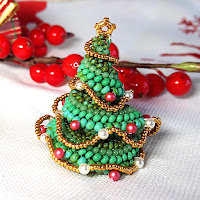
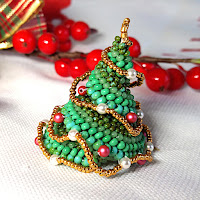
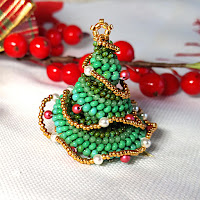
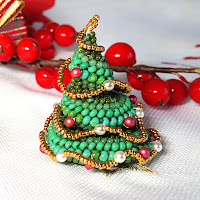
For this little green Cellini tree, I used a sequence with softly increasing sizes of Czech seed beads (11°, 10°, 9° and 8°). Below the 4 photos show it from each side.

Yes, it is a wonky tree. And the more I look at it, the more I love it. No need for perfection. We need variation.

 I tried to do a live demo on FB, but it didn't work right.

The videos with the instructions are posted in the FB Cellini peyote freaks group. I hope that you will enjoy making your version with your favorite colours and look forward to seeing it.

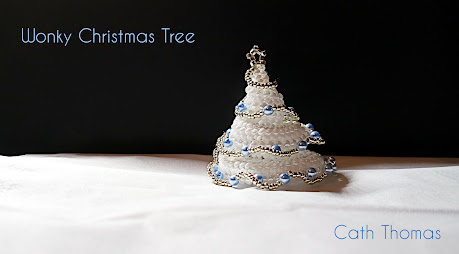
I also tried to use Japanese seed beads and see what I could substitute. That resulted in this pretty white wonky tree. 

And now members are testing various combos and it is really interesting to work on this together, to bead together. 

Even if far apart, we are close, we are a family. A family of beaders. 

And thanks to this experiment, I discovered that "crooked little Christmas trees are actually a thing. Charly Brown, Grinchmas and even an adorable Christmas tale all feature wonky trees. 

This is a link to a nice lecture, with beautiful
illustrations, great to watch with kids.

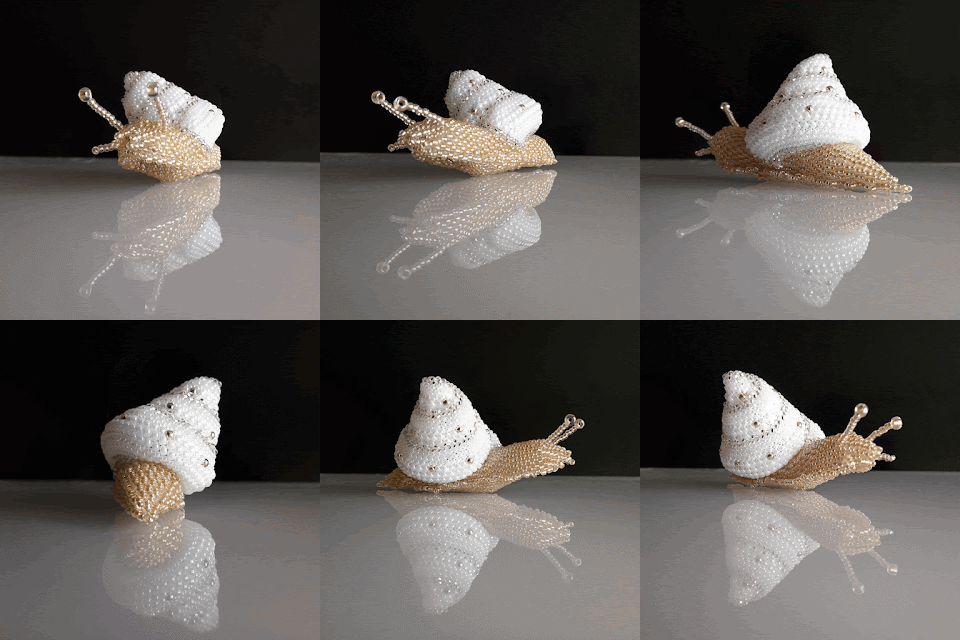
One thing leading to another, I had to try another snail after making my Wonky tree, of course, but it was far more complex to do than I thought and it took me quite a bit of trial and error, but I am so pleased with the result! So much better than my previous snails.
I hope to tutify this pretty "Snow Snail" next year.


During this challenging year, meeting with fellow beaders through Zoom and Facebook has helped me very much to stay positive and creative, and I hope that this is the case, somehow, for you too.


May the holidays be happy and cosy, may you stay safe, and find reasons to rejoice, even if it are only "the little things".

Merry Christmas to all who celebrate.

Cath

Friday, August 6, 2021

International Beading Week 2021

By golly, what a week, my friends, what a wonderful week this has been! 

Thanks to the ever so dedicated folks of the Beadworkers Guild, we've had the most wonderful online celebration ever with beads. 

It was like a very good cuvée of champagne: great taste, festive bubbles and no headache afterwards.

 Every day a new stitch to talk about and lovely promps and quotes, meetings, a fabulous prize draw and many thing learned. It was fantastic. Even a new international common project has been launched, once more, by Sam Norgard, the "All Colors" project.

It was wonderful to Zoom-meet with people from around the globe. In particular those I've had contact with since so many years. I never dreamt that I'd see them one day in real life. Among these persons were Karen Beningfield from South Africa (beader and designer, member of and graphic illustrator for Contemporary Geometric Beadwork, who also helped me with the edition of the Diamond Weave book), Cate Venn, who is the most inspirational person & part of my "totem", and her husband Christopher Venn, who beads entire dresses in black tiny size 15° seed beads, and Nancy Jenner Kooyers, who is an incredibly talented beader who normally doesn't write patterns, but this year offered a pattern for the most adorable beaded faerie ever. If you haven't seen this tiny fairy yet, come and visit Facebook where they are popping up everywhere and are so cute!

The ambassadors and other designers gave us marvelous designs to play with. You can still download them from the Beadworkers Guild website. The patterns remain there after IBW is over. The collection of goodies is growing each year, and the contributions are amazing.

As every year, I offered a tutorial too. Two, in fact. One for the duration of the week only, to make a Gazebo Cascading tassle, and one for my Year Long Rainbow Project, which is a freeform peyote piece called Rivers of Color. 

The guide can be downloaded for free from my website. I call it a guide, because freeform creations cannot be completely copied. I think, however, that folks will have loads of fun trying this method.

Talking about the year long rainbow challenge: look at the pieces below!!! 

These are the creations of the participants who finished their project this year! I am each year amazed by how much talent there is out there, and by the variety of the pieces too.

Teresa "Keygirl" Shelton created a beautiful geometric bangle made with a clever method of her "cru": "Starts and ends with 3". She also offered her pattern to the BWG to be added to the IBW pattern page.


Diane De Gooyer made a set of bangles to have something to wear every day. Clever!


Diàna Balogh made a bangle with hundreds of little flowers, made with a gazillion little seed beads. We all want to know how she did this. Hopefull she will tell us in an upcoming Journal?


Jessica Hayman created an "eggbox" with intricate celtic knots in the most exquisite camaieu of colors of the rainbow. Mind blown!
And she donated the pattern for 1 knot to the list of IBW goodies!!


Margaret Haigh made her own necklace using the elements from the pattern "Square dance" designed by Heather Kingsley Heath - the pattern is available on the IBW pattern page of the Guild.


Caroline Lloyd created a stylish "French flowers" arrangement. It is incredible how only a few beaded leaves and flowers can become something so complete.


Nancy Deonarine beaded a collection of sparkling peyote pod ornaments - her colors match the IBW logo perfectly.

Teréz Kocsis made lovely little sparkly daisies.


Shelley Gillmann started with the yellow, orange and next colors of the IBW logo and then got so carried away that she didn't make jewelry, but 35 designs for "carrier beads", now offered as one of the IBW freebies for this year. The photo above shows 14 of them.

 Huge compliments to all!

And many thanks to all those who contributed patterns!
The next season is going to be beadybusy!

If you haven't tried yet, come and make a rainbow yourself this year! Each month a little something and at the end of the year you end up having something huge! Like this epic piece by Karan Parker from back in 2018 which I still adore.


Join the Facebook group to post your progress, find tips, or encouragement. 

Happy beading everyone!


Cath