When I saw the Beadworkers Guild challenge theme for 2019, "Jewels of the Nile", my first thought was to not make a collar. No way! Because there are so many out there already and amazing ones. So I searched for what could be another Jewel of the Nile and found the Egyptian blue lotus flower and god Nefertum.
Oh my!
 |
| Nymphaea caerulea. The Egyptian blue lotus is, in fact, a waterlily, but most call it the Egyptian blue lotus |
I instantly fell in love with this beautiful waterlily and started my first creation immediately: a small vessel for tooth picks representing the waters of the Nile with the flower floating atop of it.

 However, this was not a very stable construction, and the crystal beads in the vessel - which is a bola canastas made with diagonal Cellini peyote - cut the thread without mercy. Twice...
This had the merit to answer my question as to keep the flower as a toothpick holder or not: I repaired the vessel mimicing the art of Kitsugi to forever remind me that crystals are not bola-friendly, and made that a nice toothpick holder, and created a barrette with the flower (not yet finished).

This is a sign that Eddie didn't hear it this way (Eddie is my muse and tyrant). He wanted a wesekh. Nefertum's wesekh. Bead woven. Of course!
The rules of the Guild's challenge say "we urge members to concentrate on the personal challenge - to be as good as they can, rather than pitting themselves against others". Bead embroidery would not have been easy for me. Rather the contrary. But to weave a dense collar with a curve that doesn't ruffle yet still moves with the wearer's movements, is a challenge, at least for me. So I gave in.
But before writing more about the making of the collar, I wish to tell more about lord Nefertum and his attribute, the sacred blue lotus:
 |
| Antelope with lotus flower |
While doing my research, I discovered that lotus flowers can be seen in countless ancient Egyptian tomb wall paintings and temple carvings, from the oldest to the most recent dynasties. It is everywhere: in people's hair or hands, in large collars, on piles of offerings to the gods, etc. Even around an antelope's neck. Some temples even have columns with lotus-inspired forms.
 |
| Painting of Funeral banquet in Rekhmire's tomb at Luxor, showing servants offering lotus flower necklaces to female guests who are seated on mats. Photo Mick Palarczyk and Paul Smit |
In early Egyptian mythology, Nefertum was believed to be the first god, the young Atum (Nefertum means beautiful Atum, or youthful Atum), who came
 |
| Egypt, Tomb of Ramses I, Pharaoh (center) presenting offerings to Nefertum (left) |
Atum was a solar deity, so Nefertum represented the sunrise. He matured into Atum during the day before passing into the world of the dead with every sunset.
Later, as time wore on, Atum became assimilated into Ra (as Atum-Ra), the sacred scarab became the symbol of the rising sun, and so it came to be that people regarded Nefertum as a separate deity. The lotus flower never lost its popularity though. Rather the contrary.
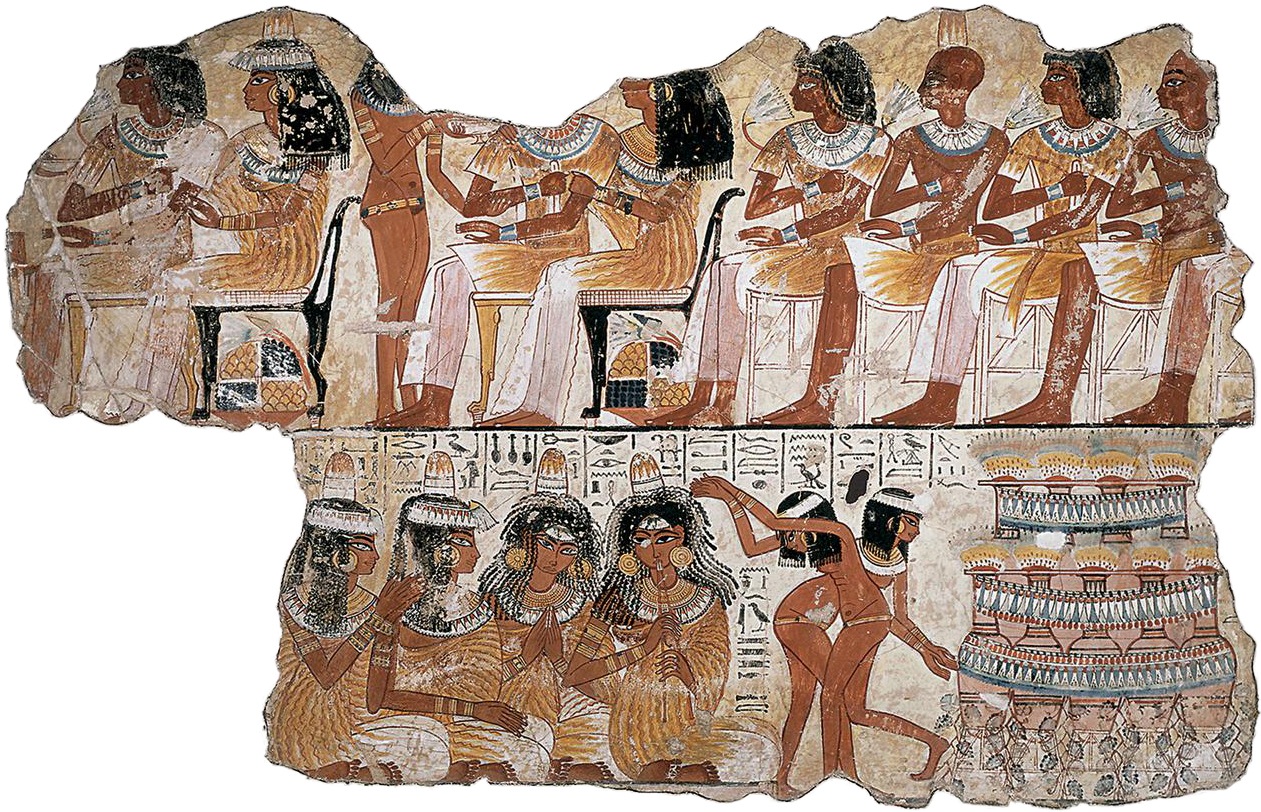 |
| Another funeral banquet (of Nebamum) showing musicians and servants dancing and offering lotus flowers and flower necklaces to guests |
 |
| The Egyptian geranium smells like roses |
"Rise like Nefertum from the blue water lily, to the nostrils of Ra (the creator and sungod), and come forth upon the horizon each day."
 |
| Priest (botanist or aromatherapist?) with botanical attributes and offerings. |
Nefertum eventually became the lord of perfumes, patron of the cosmetic and healing arts derived from flowers. Associated to other medicinal flowers, such as geranium (another divine smell) and cornflower, he could be described as the archetypal aromatherapist.
Actually, this blue lotus study made me order blue lotus essential oil. It smells divine and has no narcotic effects. Learn more about my love of scents in my article Perfumes and Pomanders.
What is a wesekh and / or a menat
I thought that a broad collar was called a menat, another name of goddess Hathor, whose attribute was a collar with a heavy counterpoise. It was used by her and her priestesses as a rattle for blessings.
In fact, wesekh is the name of the large Egyptian collar, thought to have many (protective) properties, hence worn by men and by women, and the menat is the name of the counterpoise, keeping it in place.
 |
| 18th Dynasty Menat (approx. 1300 BC) |
Many ancient Egyptian wesekh represent the wings of a vulture or a scarab. The golden counterpoises in the one shown below can hold it without need for a clasp. If you look at the two images below in full screen you can appreciate the fine craftsmanship of the Egyptians.
 |
| Senebtisi's collar, formed of two golden falcon heads. Approx. 1850-1775 B.C. © The Metropolitan Museum of Arts, New-York |
The colors
The Brooklyn Museum experts say: "For the Egyptians the lighter shade of blue was almost interchangeable with green, the color of the sea, plants, vegetation, and thus health and life. The darker shade of blue was associated with the dark primordial waters out of which creation first appeared, as well as the night sky through which the sun-god traveled to be reborn every morning. Naturally, blue-green faience and blue glass were cheaper alternatives to turquoise and lapis-lazuli."
Obviously, bugle beads and dagger beads are not new beads :) Isn't this amazing?
Techniques
The ancient Egyptians invented enameling. They were master goldsmiths. They were masters at bead making and bead weaving. They even made some sort of seed beads. The piece above includes incredibly tiny seed beads. Looking closer at it, I realized that my collar looks as if it is made with a method very similar to the one they used.
The Egyptians already used peyote stitch to weave seed beads. A pair of beaded sandals found back in King Tut's tomb attests of this technique and of the "seed" beads existing already back then (although probably not made like seed beads, but rather one by one, by hand...)
The Brooklyn Museum experts say: "For the Egyptians the lighter shade of blue was almost interchangeable with green, the color of the sea, plants, vegetation, and thus health and life. The darker shade of blue was associated with the dark primordial waters out of which creation first appeared, as well as the night sky through which the sun-god traveled to be reborn every morning. Naturally, blue-green faience and blue glass were cheaper alternatives to turquoise and lapis-lazuli."
Obviously, bugle beads and dagger beads are not new beads :) Isn't this amazing?
 |
| Broad Collar, ca. 1336-1327 B.C.E., ca. 1327-1323 B.C.E., or ca.1323-1295 B.C.E. Faience, 14 7/16 x 4 7/16 in. (36.6 x 11.3 cm). Brooklyn Museum, Charles Edwin Wilbour Fund, 40.522. Creative Commons-BY (Photo: Brooklyn Museum, 40.522_SL1.jpg) Visit the Brooklyn's Museum page to learn more about this piece. |
Techniques
The ancient Egyptians invented enameling. They were master goldsmiths. They were masters at bead making and bead weaving. They even made some sort of seed beads. The piece above includes incredibly tiny seed beads. Looking closer at it, I realized that my collar looks as if it is made with a method very similar to the one they used.
The Egyptians already used peyote stitch to weave seed beads. A pair of beaded sandals found back in King Tut's tomb attests of this technique and of the "seed" beads existing already back then (although probably not made like seed beads, but rather one by one, by hand...)
 |
| King Tutankhamon's sandals made with "peyote" stitch |
Making of my challenge piece, Nefertum's wesekh
I found the idea of humans created by the tears of the morning sun or god a wonderful legend, so I planned on including teardrops in the collar as a main design feature. Even if faceted gemstones, or diamonds, are not present in ancient Egyptian jewellery, this was the story that I decided to translate
Like all important deities, one of Nefertum's attributes is the Ankh symbol. I first thought of using it for the clasp, but my second carnelian cabochon had a white stripe across and was begging to be transformed into a scarab. I made a scarab clasp with it.
Techniques used: a mix of netting and DW for a dense weave. It was difficult to get the curve right, but the result is so delightful to wear. It perfectly adapts to my neck and movements and doesn't ruffle!
 |
| Decisions, decisions.... |

 |
| Matching earrings |
As for challenging myself: nearly everything in this collar was out of my comfort zone: unusual colors (for me), stitches I nearly never use, bead embroidery, and a difficult theme for my usual style: it is hard to keep proportions small or medium when it comes to this magnificent civilization.

Cherry on the cake: the hubby said that Cleopatra would have killed to have it!
Thank you very much fore reading this long article!
 |
| My beading mat looked like a battle field. |
 |
| Clasp |
I couldn't be happier with this necklace. When I wear it, I feel amazing!

Cherry on the cake: the hubby said that Cleopatra would have killed to have it!
| One more photo of the earrings: |
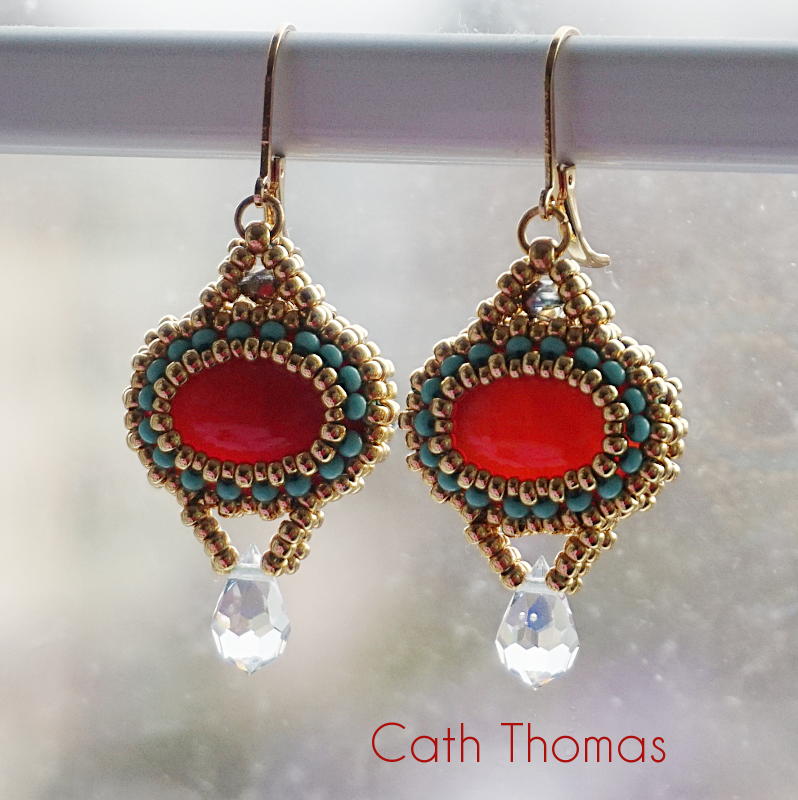 |
| I love how they let the light shine through. |
Thank you very much fore reading this long article!
Cath,
incredibly happy winner of the first place in the "Expert" category of the BWG 2019 Challenge.
Become a member of the Beadworker's Guild - we're a beautiful family of beaders united by our love of beading, and get their beautiful Journal 4 times per year
incredibly happy winner of the first place in the "Expert" category of the BWG 2019 Challenge.
Become a member of the Beadworker's Guild - we're a beautiful family of beaders united by our love of beading, and get their beautiful Journal 4 times per year
